

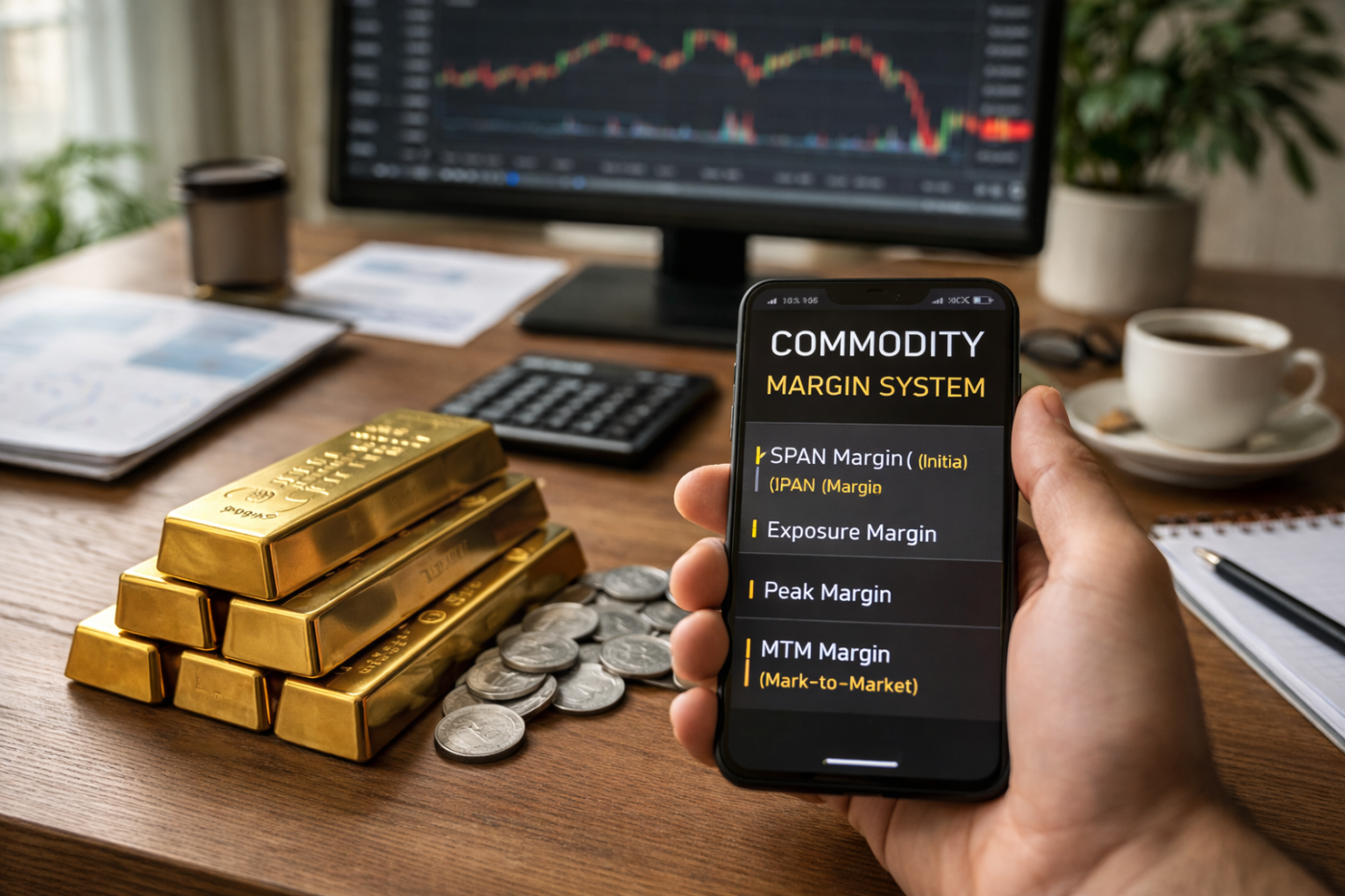
Every trade in the commodity derivatives market begins not with full capital deployment but with a margin deposit. The margin system in commodity markets is the foundation that enables leveraged trading while ensuring systemic stability across exchanges like MCX. For Indian traders dealing in gold, crude oil, silver, and agri commodities, margins dictate how much exposure can be taken, how risk is managed, and when positions may be forced to close.
In recent years, tighter regulatory norms, peak margin rules, and heightened volatility across global commodities have made margin mechanics even more critical. A trader who understands margins understands survival in futures markets.
This article breaks down the margin framework used in Indian commodity markets, explains how margins are calculated, why they change, and what professional traders watch when margins move.
What Is the Margin System in Commodity Markets
Margins are essentially a security deposit required to open and maintain futures positions. Unlike equity delivery trades where full payment is required, commodity futures operate on leverage. The exchange collects margins to ensure that all participants can meet their obligations even during sharp price swings.
Margins serve three primary purposes:
- Protect the clearing system from default
- Control excessive leverage
- Ensure daily settlement of losses
Without margins, commodity markets would face severe settlement risks during volatile sessions.
Types of Margins in MCX Commodity Trading
Commodity exchanges in India follow a layered margin structure. Each layer addresses a specific risk scenario.
SPAN Margin (Initial Margin)
SPAN (Standard Portfolio Analysis of Risk) is the core margin required to initiate a trade. It is calculated using advanced risk modeling that simulates worst-case price movements across scenarios.
Factors affecting SPAN margin:
- Price volatility
- Contract size
- Historical movement
- Liquidity
When volatility rises, SPAN margin increases automatically.
Exposure Margin
Exposure margin is an additional buffer imposed by the exchange to safeguard against extreme price movements beyond modeled scenarios.
It is:
- Charged along with SPAN
- Fixed percentage of contract value
- Mandatory for all traders
Mark-to-Market (MTM) Margin
Commodity markets follow daily settlement through MTM. At the end of each trading day:
- Losses are deducted from margin balance
- Profits are credited
- Additional margin may be required if balance falls
This ensures risk is settled daily rather than accumulating until expiry.
Peak Margin Requirement
Peak margin rules ensure traders maintain adequate margin throughout the trading session, not just at end-of-day. This reduces excessive intraday leverage and improves system safety.
Margin Components Overview (Mobile Friendly)
| Margin | Role | Applied When |
|---|---|---|
| SPAN | Base risk coverage | Trade entry |
| Exposure | Extra buffer | With SPAN |
| MTM | Daily P/L settlement | End of day |
| Peak | Intraday control | All session |
How Margin Enables Leverage
Margins allow traders to control large contract values with relatively small capital.
Example: Gold Futures
| Parameter | Value |
|---|---|
| Contract value | ₹60,00,000 |
| Margin required | ₹6,00,000 |
| Leverage | ~10x |
This means a trader can control ₹60 lakh worth of gold with ₹6 lakh margin. While this magnifies potential returns, it equally magnifies risk.
Why Margin Requirements Change
Margins are dynamic and frequently revised by exchanges. They change based on market risk conditions.
Key Triggers
| Trigger | Margin Impact |
|---|---|
| High volatility | Increase |
| Stable market | Decrease |
| Global risk events | Increase |
| Liquidity improvement | Ease |
For example, during geopolitical tension or sharp global moves in crude oil or gold, exchanges may raise margins to prevent excessive speculation.
Indian Commodity Market Context
The Indian commodity ecosystem operates under SEBI oversight with a conservative risk framework. Compared to some global exchanges, Indian margin requirements are relatively stricter, particularly after peak margin rules were introduced.
Structural Features
- Strong clearing mechanism
- Daily MTM settlement
- Strict leverage control
- Mandatory margin reporting
This has improved market resilience during volatile global cycles.
Professional Interpretation of Margin Changes
Margin changes often provide early signals about market conditions.
When Margins Rise
- Volatility expected
- Risk perception increases
- Traders reduce leverage
When Margins Fall
- Market stabilizing
- Liquidity improving
- Confidence returning
Margin Signals Table
| Margin Move | Market Signal |
|---|---|
| Rising margins | Volatility ahead |
| Falling margins | Stability |
| Sudden hike | Risk event |
| Gradual drop | Confidence |
Professional traders track these adjustments closely because they affect position sizing and capital allocation.
Commodity Margin Range (Indicative)
| Commodity | Margin Range |
|---|---|
| Gold | 8–12% |
| Silver | 10–15% |
| Crude Oil | 12–20% |
| Natural Gas | 20–30% |
Actual margin varies depending on volatility and exchange risk assessment.
Futures vs Cash Market Capital Requirement
| Factor | Futures | Cash |
|---|---|---|
| Capital needed | Margin | Full value |
| Leverage | High | Low |
| Risk | Higher | Lower |
| Settlement | Daily MTM | On sale |
Commodity futures rely heavily on margins, unlike delivery-based markets.
Risk Implications for Traders
Leverage is attractive but dangerous without discipline.
Key Risks
- Margin calls
- Forced liquidation
- Rapid capital erosion
Best Practices
- Maintain extra buffer margin
- Avoid maximum leverage
- Monitor volatility
Experienced traders rarely deploy full margin capacity.
Practical Interpretation for Market Participants
For Retail Traders
- Treat margin as risk capital
- Track margin updates daily
- Avoid emotional averaging
For Hedgers
- Margin acts as working capital
- Helps lock commodity prices
- Reduces business uncertainty
For Investors
Commodity trading is not passive investing. It requires monitoring and discipline.
Common Mistakes
- Using full leverage
- Ignoring MTM losses
- Not tracking margin changes
- Holding positions during volatility spikes
These often result in forced position closures.
Why Margin System Is Structurally Important
Margins protect:
- Exchanges
- Brokers
- Traders
- Clearing corporations
They ensure orderly settlement even during extreme price swings.
FAQ: Margin System in Commodity Markets
What is margin in commodity trading?
A security deposit required to open futures positions.
Is margin a fee?
No. It is refundable unless losses occur.
Why do margins increase suddenly?
Due to volatility or global risk.
What is MTM settlement?
Daily adjustment of profit and loss.
Can exchanges close positions automatically?
Yes, if margin falls below required levels.
Is commodity trading risky?
Yes, due to leverage and volatility.
Market Perspective: Why This Matters in 2026
With rising participation from retail traders and algorithmic systems, margin discipline has become central to commodity trading. Volatility driven by global interest rates, currency fluctuations, and geopolitical shifts means margins will remain dynamic.
Understanding margin mechanics is now a prerequisite—not an optional skill—for anyone trading on MCX.
Conclusion
The margin system in commodity markets is the backbone of futures trading. It enables leverage while protecting the financial ecosystem from cascading defaults. For traders and investors in India, understanding SPAN margin, exposure margin, MTM settlement, and peak margin rules is essential for survival and long-term consistency.
Margins define not just how much you can trade—but how long you can stay in the market.
Disclaimer
This content is for informational and educational purposes only and does not constitute financial or investment advice.