
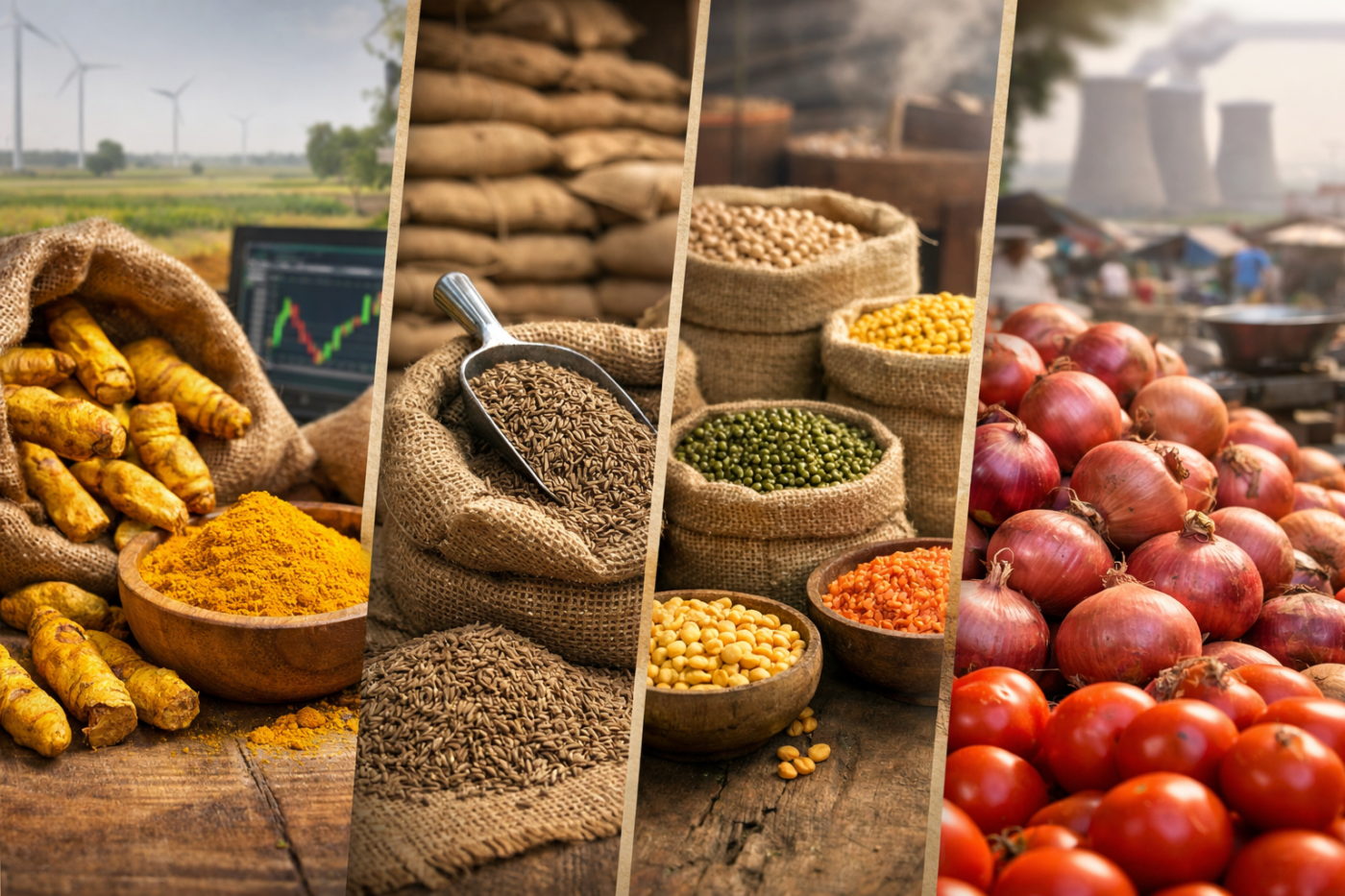
The Indian agricultural landscape in early 2026 is a study in contrasts. While the “spices of life” are seeing historic price movements on the NCDEX (National Commodity and Derivatives Exchange), the essential staples—pulses and vegetables—are caught between aggressive government intervention and seasonal supply shocks. For investors, traders, and consumers, understanding these shifts is no longer optional; it is a necessity for financial planning in a high-inflation environment.
1. Spices: The Polarized Market of Turmeric and Jeera
The spice complex is currently the most active segment of the Indian commodity market. February 2026 has seen a significant decoupling between Turmeric and Jeera (Cumin).
The Turmeric “Bull Run” (NCDEX: TMCFGRNZM)
Turmeric has emerged as the superstar of early 2026. Prices have recently breached the ₹16,000 per quintal mark, fueled by a 4% surge in a single trading session.
- Supply Constraints: Production estimates for the 2025-26 season have been revised downward to 1.14 million tons, compared to earlier projections. Tight carryover stocks from the previous year have left the market with little buffer.
- Export Demand: India, as the world’s leading producer and exporter, is seeing robust demand from the pharmaceutical and cosmetic sectors, where turmeric’s anti-inflammatory properties remain high-value.
- Price Outlook: While new arrivals in Erode and Nizamabad may offer brief cooling periods, the structural deficit suggests a sustained bullish trend for the first half of 2026.
Jeera: The Weight of Abundance
In stark contrast, Jeera is trading under pressure. At the Unjha spot market, prices have softened to approximately ₹23,000 per quintal.
- High Arrivals: Daily arrivals at major hubs like Gondal and Unjha are topping 3,000–8,000 bags.
- Market Sentiment: With ample stocks and tepid export interest, the near-term outlook remains weak. However, analysts suggest that if weather issues persist in Rajasthan’s growing belts, we could see a floor price established soon.
2. Pulses (Dals): The “Bharat Dal” Stabilization Effect
India’s pulses market is currently defined by a “two-tier” pricing system: the open market vs. government-subsidized retail.
Tur and Arhar Dal
Tur dal remains the most “expensive” in the bowl, hovering around ₹121/kg in retail.
- The Squeeze: Below-normal arrivals of the new crop in Karnataka and Maharashtra have kept prices elevated.
- Government Intervention: To counter this, the government is aggressively procuring Tur at an MSP of ₹8,000 per 100 kg to build a buffer and prevent hoarding.
Chana Dal (Gram)
Chana is the success story of 2026. Prices have cooled to ₹81-85/kg, largely due to the Bharat Dal Phase-II initiative.
- Subsidy Impact: By selling processed Chana Dal at ₹70/kg and Chana Whole at ₹58/kg through mobile vans and cooperative outlets, the government has successfully capped open-market inflation.
| Commodity | Market Price (Avg) | Government Price (Bharat Brand) | Trend |
| Tur Dal | ₹121/kg | N/A | 📈 Rising |
| Chana Dal | ₹85/kg | ₹70/kg | 📉 Stable |
| Moong Dal | ₹115/kg | ₹107/kg | ↔️ Neutral |
3. Vegetable Volatility: The Onion-Tomato Swap
If 2025 was the year of the Tomato crisis, 2026 is becoming the year of Onion anxiety.
The Onion Firming
As storage stocks from the previous Rabi harvest deplete, onion prices are beginning to “firm up.”
- Storage Depletion: The Rabi crop, which accounts for 60% of India’s output, is reaching the end of its shelf life.
- The “Wait and Watch”: Prices are expected to remain volatile until the late Kharif and early Rabi arrivals hit the market in full force by late March.
The Tomato Cool-down
Tomato prices have staged a dramatic retreat. From the triple-digit peaks seen in January, prices have settled at a much more manageable ₹31/kg in major metros. Improved supply chains and better weather in Karnataka and Maharashtra have flooded the “mandis,” providing much-needed relief to the common man’s kitchen budget.
4. Expert Insights: Strategies for 2026
Agricultural economists suggest that the “Agri-Commodity Supercycle” in India is being driven by Climate Vulnerability.
“We are seeing a permanent shift in how food prices behave. Traditional seasonality is being replaced by ‘micro-shocks’—unseasonal rain or heatwaves that can swing prices by 20% in a week. Diversification into DeepTech-led farming and modern cold storage is the only long-term hedge.”
FAQ: Frequently Asked Questions
Q1: Why is Turmeric rising while Jeera is falling?
A: Turmeric is facing a production deficit (low supply) and high pharma demand, while Jeera is seeing a surplus of new crop arrivals in Gujarat and Rajasthan.
Q2: Will “Bharat Dal” prices increase soon?
A: Unlikely. The government currently holds a stock of over 3 lakh tons of Chana specifically for the Bharat brand to maintain price stability through the festive season.
Q3: Is it a good time to invest in Agri-Commodity futures?
A: For short-term traders, Turmeric offers momentum, but high volatility makes it risky. Long-term investors are looking at Copper and Zinc as better “industrial-agri” proxies.
Summary
The Indian agri-commodity market in 2026 is no longer just about the monsoon; it’s about intervention and infrastructure. While spices like Turmeric offer high-reward opportunities for traders, the stability of pulses like Chana showcases the power of government branding in controlling inflation. As we move into the heat of the summer months, monitoring storage levels for onions and the arrival pace of the Rabi crop will be the key to navigating this “Mixed Bag” market.