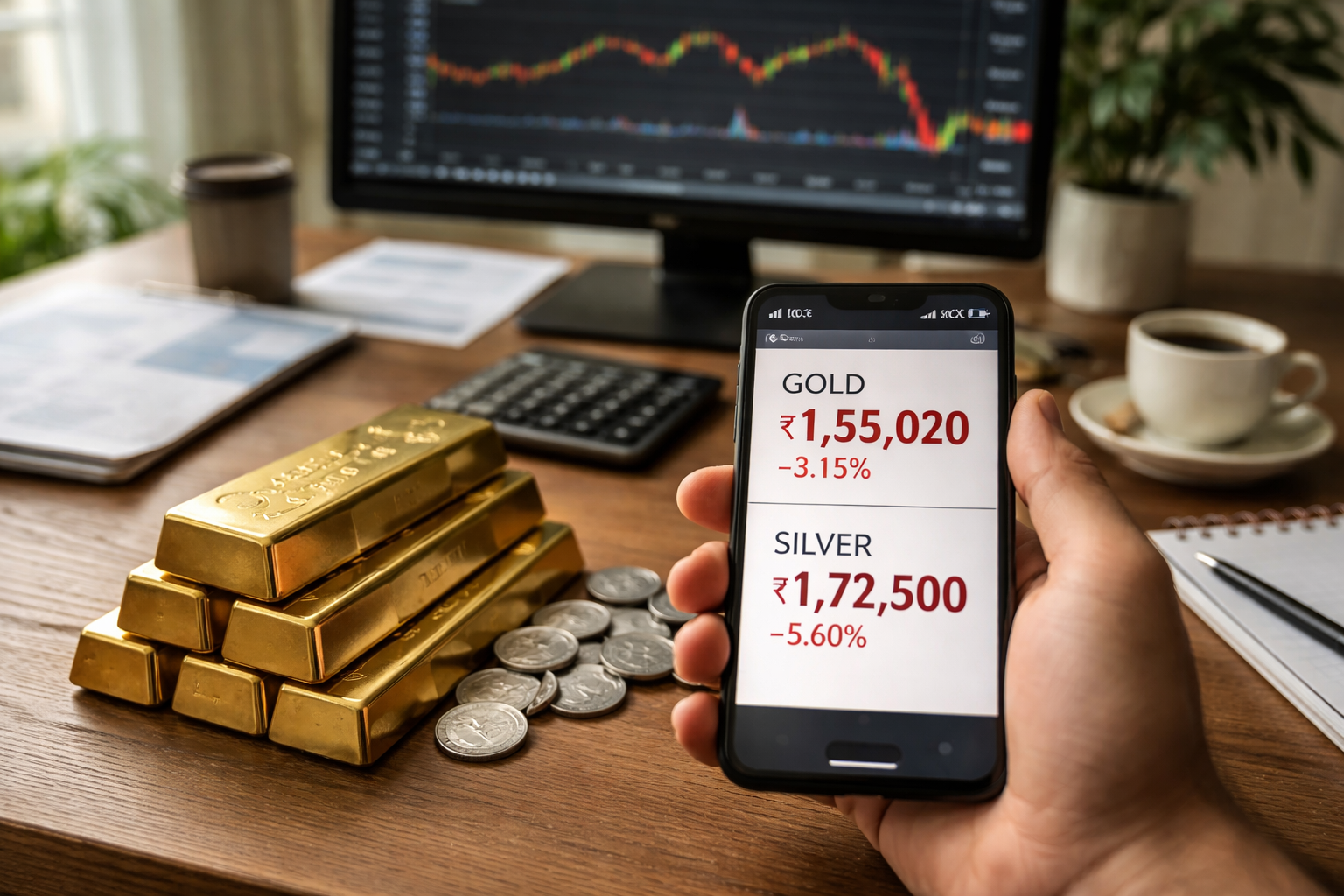
A sharp correction in precious metals has caught the attention of Indian market participants. The MCX gold price drop in February 2026—reportedly pushing gold futures toward the ₹1,55,000 per 10 grams mark—has triggered intense debate across trading desks, brokerage houses, and retail investor forums. Simultaneously, silver futures decline has amplified concerns about whether this is a routine pullback or the beginning of a deeper cyclical shift.
For India, where gold is both an emotional asset and a macro hedge, price movements on the Multi Commodity Exchange (MCX) carry outsized importance. From hedgers and jewellers to systematic commodity traders, everyone is watching this correction closely.
This article examines the structural reasons behind the February 2026 gold correction, the global macro drivers influencing the gold rate today India, and what experienced market professionals are reading into the move. Beyond price action, the goal is to interpret market behavior and identify signals worth monitoring in the coming weeks.
What Triggered the MCX Gold Price Drop in February 2026
Profit Booking After Extended Rally
The most immediate trigger behind the MCX gold price drop appears to be aggressive profit booking after an extended rally in late-2025 and early-2026. Gold had rallied strongly amid geopolitical uncertainty, central bank buying, and currency volatility.
Once prices approached record territory, institutional traders began locking in gains.
Key dynamics:
- Funds trimmed long positions
- Traders squared off leveraged bets
- Short-term speculative positions unwound
This type of correction is typical after parabolic moves in commodities. When prices rise quickly, corrections tend to be sharp rather than gradual.
Global Cues: Dollar Strength and Bond Yields
Gold rarely moves in isolation. The February 2026 gold correction has been heavily influenced by global macro signals.
US Dollar Strength
A strengthening dollar makes gold more expensive for non-US buyers. When the dollar index rises, gold typically faces pressure.
Bond Yield Movement
Higher real yields reduce gold’s appeal because gold does not generate interest. Even a modest rise in US Treasury yields can trigger selling.
Risk-On Sentiment
If equity markets stabilize or rally, safe-haven demand for gold tends to weaken.
Table: Key Drivers Behind the Current Correction
| Factor | Direction | Market Impact |
|---|---|---|
| Profit booking | High | Short-term selling pressure |
| Dollar strength | Rising | Bearish for gold |
| Bond yields | Firm | Reduces gold appeal |
| ETF flows | Mixed | Volatility spike |
| Rupee movement | Stable to weak | Partial support to MCX |
Silver Futures Decline: Why Silver Is Falling Faster
Silver tends to amplify gold’s moves. When gold corrects, silver often falls more sharply due to its industrial demand component.
Industrial Demand Sensitivity
Unlike gold, silver has strong links to:
- Electronics
- Solar manufacturing
- Industrial production
If global growth signals soften, silver becomes vulnerable.
Speculative Positioning
Silver markets typically have higher speculative participation. When traders exit positions quickly, volatility spikes.
Table: Gold vs Silver Correction Dynamics
| Parameter | Gold | Silver |
|---|---|---|
| Volatility | Moderate | High |
| Safe-haven demand | Strong | Moderate |
| Industrial link | Low | High |
| Correction speed | Slower | Faster |
MCX Price Dynamics: Why Indian Prices React Differently
The gold rate today India is not purely a reflection of international prices. MCX prices incorporate:
- Global COMEX gold price
- USD/INR exchange rate
- Import duty
- Local demand
Even when global gold corrects, rupee depreciation can cushion MCX prices.
Rupee Factor
If the rupee weakens:
- MCX gold may fall less
- Silver decline may be limited
If the rupee strengthens:
- Corrections deepen
Is This a Structural Trend or Short-Term Correction?
Market professionals differentiate between technical correction and trend reversal.
Current indicators suggest:
- Position unwinding rather than structural collapse
- No major shift in central bank gold buying
- Inflation expectations still elevated
This suggests the February 2026 gold correction may be cyclical rather than structural.
However, if global liquidity tightens significantly, downside risks could expand.
Expert Interpretation: How Professionals Are Reading the Move
Experienced commodity traders interpret this phase through positioning and macro signals rather than headlines.
Institutional View
- Healthy correction after rally
- Opportunity for re-entry at lower levels
- Watch global yields
Retail Behavior
- Panic selling near corrections
- Over-reaction to short-term volatility
Structural Signals to Monitor
- Central bank buying data
- ETF flows
- Dollar index trajectory
- US rate outlook
Data Snapshot: Gold and Silver Movement (Illustrative)
| Asset | Recent High | Current Range | Correction % |
|---|---|---|---|
| MCX Gold | ₹1,60,000 | ₹1,55,000 | ~3–4% |
| MCX Silver | ₹1,85,000/kg | ₹1,72,000/kg | ~7% |
Note: Figures indicative for analysis context.
Indian Market Context: Demand vs Price
India’s physical demand often increases when prices correct.
Jewellery Demand
Lower prices typically trigger:
- Wedding season buying
- Retail accumulation
Investor Demand
Gold ETFs and sovereign gold bonds may see renewed interest during dips.
Global Comparison: How India Differs
| Market | Reaction to Correction |
|---|---|
| US | Futures-led trading |
| China | Physical demand driven |
| India | Hybrid: physical + futures |
India’s market often stabilizes quicker due to physical buying support.
Practical Interpretation for Market Participants
For Traders
- Watch support zones
- Monitor dollar index
- Track open interest
For Investors
- Corrections are normal
- Avoid chasing momentum
- Track macro signals
Common Mistakes
- Panic selling during corrections
- Ignoring currency impact
- Over-leveraging
Market Signals to Watch Next
- US inflation data
- Federal Reserve outlook
- Dollar movement
- ETF inflows/outflows
- Geopolitical developments
These will determine whether the MCX gold price drop stabilizes or extends.
FAQ: MCX Gold and Silver Correction
Why is gold falling in February 2026?
Profit booking, stronger dollar, and rising bond yields are key reasons.
Is the gold correction temporary?
Current indicators suggest a cyclical correction rather than a structural downtrend.
Why is silver falling more than gold?
Silver has higher volatility and stronger links to industrial demand.
Does rupee movement affect MCX prices?
Yes. A weaker rupee can limit downside in MCX gold and silver.
Is this a good time to accumulate gold?
Corrections often attract long-term investors, but markets remain volatile.
What should traders watch now?
Dollar index, global yields, and open interest trends.
Market Perspective: Why This Matters in 2026
The February 2026 gold correction is occurring in a market shaped by:
- Persistent inflation concerns
- Central bank diversification
- Currency volatility
Gold remains a macro asset tied to global liquidity cycles. Corrections like the current one often reset positioning rather than end trends.
If global uncertainty persists, gold may regain momentum. If yields rise further, consolidation could continue.
Conclusion
The recent MCX gold price drop and silver futures decline reflect a classic market phase: sharp rally followed by profit-driven correction under shifting global cues. While short-term volatility may persist, structural demand drivers for precious metals remain intact.
For Indian market participants, understanding the interplay between global signals, currency movement, and domestic demand is essential. Rather than reacting emotionally to price swings, interpreting the broader macro narrative offers better clarity.
The coming weeks will determine whether the gold rate today India stabilizes or tests deeper support levels. Either way, this correction underscores a key principle of commodity markets: momentum and mean reversion often coexist.
Disclaimer
This content is for informational and educational purposes only and does not constitute financial or investment advice.